Sunday, October 30, 2011

Political Cartoon - Corrupted Justices


In this political cartoon, the nine future justices are shown; two of them look like power-hungry politicians, five of them are elephants, and the remaining two look to be sane and logical. There is the presence of the balloon bubble that says, “Okay, let’s take a vote.”

My first reaction to this political cartoon was that in the future, our government is going to be corrupt; the so-called balance of powers will be shattered and corrupt politicians will rule the country. The U.S. will then become a power-hungry country and wage war against multiple countries because our new policies would make other countries mad at us. The people that actually know how politics work and how to handle such problems are few to none, and even so, they would get outvoted by the people who want power, as seen in this political cartoon. The two reasonable people among the justices are outvoted two to seven by the other justices. If this is the future of our legal system… then it does not bode well for the U.S. in the future. We’ll probably impeach the president because he or she littered or something minuscule like that, thanks to this flawed system.

This political cartoon seems to present the idea that something is wrong with the U.S. government and the artist or creator wants its audience to recognize that as well. Here in the picture, there are elephants as justices. Considering this is part of a system where to even be a justice, high experience and credentials are needed, it seems to be mocking the current system that we have place. Elephants are not exactly the most intelligent when we think about animals to personify humans with, and they’re also not exactly the most serious either; the audience can’t take them seriously when they see them on a Supreme Court justice bench. This is one way the artist depicts the system as flawed; by putting some of the justices as elephants, the creator is making a point that some of the potential future justices may have sketchy credentials and have a status not really befitting of a justice. With the smirking politicians, the creator is making a point that while there are some who may be qualified to be a justice, there is also the power factor; some justices in the future could be biased in their opinions and lend support to a case that favors them more, even if the opposing side technically has a stronger case. The political cartoon evokes distrust for the government from the viewers, and makes them look at their government and question the capabilities of their personnel and wonder if they can be trusted or not.

This political cartoon does use a couple of techniques to coax its viewers into distrusting the government. The smirking politicians and the elephants alone suggest to the readers that something is wrong with the government. The two normal justices looking in awe are the people that the viewers can sympathize in and feel sorry for; in other words, they are an appeal to the audience’s emotions. The audience knows that they can’t win the vote that one of the elephant justices suggested, and therefore, they think badly of them for playing such an underhanded trick.

Back to the Future - Time Travel Technology


In this trailer of Back to The Future by Spielberg, the viewers see the main character slowly walk into what looks like a highly advanced car and activates it, turning on all the lights on the car. The car then asks him how far he will go, giving an answer of about 30 years. The car then takes off, leaving fire in its tracks.

Travelling off into the future would be a cool concept if we could develop it in the future. I could go into the future and look at how society has evolved, maybe also look at some lottery numbers while I’m there. Time travelling does present a myriad of problems though. The future would constantly change if people were time travelling back and forth. If a person time travelled, then the future he or she would see would be a future where the person was gone for however many years they decided to skip out on. When they come back, the future has already changed; it now accommodates that one extra person that went missing for however many years. Also, if people brought back technology from the future, then the future would change drastically; it could be in ruins, or be even more prosperous. Also, bring back lottery numbers would dramatically change the future, and/or cause the lottery to go out of business. Though, going to the future is a way to assess the future situation of a problem and develop ways to combat that situation. If, for example, global warming, became much more of a force in the future, we could develop ways to fight it in the present day so that that future wouldn’t exist anymore.

The purpose behind the creation of such a movie would probably be to explore the concept of time travelling; the main character in the trailer is seen travelling through time with a time machine car, explicitly showing that purpose. For a long time, we have been interested in what the future holds for us. Will we get into college? Will we have a happy life and family? Will we have a good job or strike it rich? These are all questions that we could find out if we had access to the future. But to do that, we create paradoxes within the present timeline, and possibly damage the time-space continuum. The movie does make us think about the interesting things we could do in the future, but through the potential conflicts that could arise, the audience can understand also the negative side of time travel.

One way the film trailer manipulates people into going to the theaters to watch it would actually be the lack of content in this trailer. There are only two sentences ever spoken in this trailer, and the rest was just dramatic build-up. But it works to the filmmaker’s advantage; by not giving a lot of info right away, they appeal to their audience’s natural curiosity about the film, as well as its contradictory title, with the words “back” and “future” (future is associated with going forwards). The flashy lights on the car, as well as the fire effect left behind by the car, provide that “coolness” factor of the movie, at least for the time that it was made in.

2012 - The Destruction of the Earth and its Environments


In this trailer of 2012, it shows predominantly the Earth’s destruction, as well as society’s destruction through unnatural causes. There are fireballs erupting from volcanoes and hitting the earth, tidal waves engulfing the cities, and buildings crumbling and on fire. In short, the trailer mainly showcases the various ways the Earth and society are being destroyed.

The trailer of 2012 does depict a future where most normal people would be frightened by the self-destruction of the Earth on December 21, 2012. I have to admit that I would be scared too; knowing that any time a fireball could come and end my life or being swallowed up by the violent waters or the ground is not a fate I would prefer to die by. It does make me think back to the idea that our planet is angry at us for polluting and damaging its natural environments. Maybe this future, if it would occur in the future, would be prevented if we took extra precautions to help preserve and save the environment from further damage from burning fossil fuels and cutting trees? If the actual event did occur… I would think it would be less dramatic than what the film displays it to be, since the moviemakers has to blow everything up in proportion to make it interesting for their potential viewers, one way of manipulating them into watching their film.

The purpose behind making the film isn’t necessarily to tell the audience that this event is definitely going to happen on this date, but I think, rather to explore the possibilities of what could happen, even if they are highly unrealistic without further evidence. But, that contributes to the enjoyment; imagining different possibilities allows ideas and new hypotheses to come alive. The purpose is explicitly shown through the film trailer. The audience gets to see fireballs wreck the earth, there are numerous earthquakes that shatter the ground, and there are tidal waves that engulf nearly everything up to a certain height. These are all different possibilities that the world could come to an end when it hits 12/21/12. While it does strike fear when we think about all these different possibilities that could happen on that day, one can also say that it’s strangely amusing to think about all these different possibilities. In general, nobody that’s not naïve or stubborn would actually believe that the 2012 theory would actually come true, considering that there’s no evidence for it. In this sense, coming up with different possibilities would be an enjoyable exercise for the creative mind; it is a way to brainstorm about the future.

In this film trailer, they use a myriad of destructive images as an appeal to the audience’s curiosity of what could happen on this date. Fireballs, earthquakes, tidal waves look well done in terms of special effects, and also contribute to the sense that the movie’s quality is also well done. There is actually a lack of words or language in this trailer, with only a half of the words being said, while the other half is stated on screen. This serves to increase the dramatic tension, thereby acting also as an appeal to their audience’s taste in stories with great plotlines.

Ar Tonelico - Hymn about the World


In this hymn from Ar Tonelico, the song describes the birth of the planet, its interactions with people, or its “children”, and the eventual decline of the planet due to human anger and greed, causing the planet to be “angry” at the humans. The hymn ends off with the hope that if everyone contributes to help make the planet better, then the planet would live together with them again.

The hymn reminds me of what the world today is like. We have absurd weather patterns now, like hurricanes, earthquakes, and even snow in October. Is our Earth “angry” at us for polluting its environments with the burning of fossil fuels, as well as cutting down its trees and other natural habitats? Does the Earth want to eliminate us through severe weather patterns because we’re essentially the cause of global warming and the only species on earth that can damage its lands through nuclear warfare? As human beings, we are constantly at war with one another, causing monetary and environmental damages to the lands that we attack. It would be scary to know that the Earth is actually a sentient being that watches over all the lands and knows what is going on in the world. With all the fossil fuels being burned today, it would not look good for humanity decades later if the Earth decided to unleash its full “wrath” and decimate society. I do agree that if everybody just pitched in and respected the Earth more, like not littering on the ground or not smoking or driving the car that often, that the Earth would be a much greener place than before, and that everybody would be happier, including the Earth itself, if it had emotions. An unrealistic goal, but if we somehow accomplished that, then we’re probably one step closer to a utopia.

The overall message of the hymn seems to reflect the idea that every human being should be respecting the world and its natural lands, along with respecting each other and not waging war over greed or power. If we do that, then the Earth should be “happier” than it is now, with its random snowstorms, hurricanes, and earthquakes. The message gets across to the audience by use of a sort of scare tactic. If we continue to bicker amongst ourselves and disrespect the environment, then we are going to suffer the planet’s wrath. In a sense, it’s true because society today is already suffering from natural disasters; the earthquake in Japan, for example. After listening to this song, the audience does feel moved to respect the environment a little bit better than before; they wouldn’t want the planet to be annoyed or angry at them if the environment gets too damaged and have to live in fear of random snowstorms that break the cyclical pattern that we have.

Obviously, this depiction of the future where Mother Earth is angry at us is an idea not too far from the truth in terms of modern day activities. We are cutting down trees to make room for new buildings, burning fossil fuels, which pollutes the natural air and contributes to global warming, and waging war against one another, which in the process, also damages the lands. The Earth is in ways, a living being, though we may not think that. Right now, by polluting the environment and damaging the lands, the Earth is “sick” and “injured”. To feel better, it tries to “expel” what is causing it to be sick, or in other words, it produces random weather patterns in an attempt to shake off what’s causing it harm, similar to how humans sneeze when they have a cold.

Futuristic War Artwork


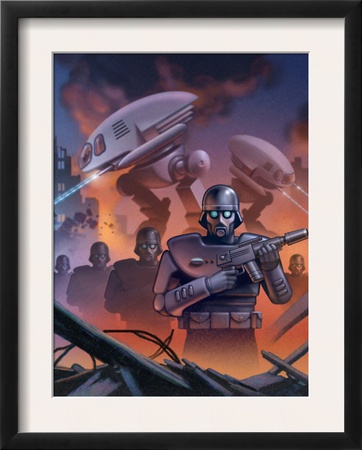
In this artwork, it depicts what looks to be society in ruins and chaos as robotic, emotionless soldiers, accompanied by war robots, lay fire and waste to the city. There’s smoke coming out from the fires, and there is debris or remains from the buildings that were destroyed in front of the soldiers’ march.

This sort of future is frightening; it suggests that a war on a grander scale could happen in the distant future and would lead the world down to ruins under the hands of a tyrannical country or world power. Or maybe, it would be a robot war; all of the soldiers and weapons used here in this picture are all mechanical. Maybe robots have developed a sense of being and realized that they were being oppressed and decided to wipe out humanity? Either way, the picture shown is ominous; it essentially depicts the end of humanity aside from maybe a couple of survivors that survived the wrath of the world power who created these machines.

The artist’s message through this artwork is probably to alert us the dangers of technology. The society of today has a general positive connotation when thinking about technology. Technology eases daily life, can help save lives, and can even provide numerous forms of entertainment in the form of movies, video games, and television. At the same time, if used in the wrong hands, technology can be also be used to create bombs, guns, or in general, just weapons of mass destruction designed for the use of war. The artist’s artwork makes us realize that; the dark and bleak colors used strengthen the overall ominous atmosphere that the artwork presents, and the presence of fire and weaponry signifies the dangers and risk associated with technology. Essentially, the core message of the artwork is that technology can be used for destructive purposes, and is not limited only to helping out society. The artwork provokes the idea from the viewers that we should be aware of both the positive and negative implications of technology; what it appears to be does not necessarily mean it’s going to be used in that way.

The promotion of technology nowadays is done through bright colors, reinforcing the positive aspects of using technology. In contrast the artist here used dark colors, reinforcing the negative aspects of technology. One wouldn’t expect the product being advertised to be “evil” if the advertisement had bright colors and an atmosphere like that as well. This is a manipulation to get us to buy the product; we associate bright colors with the idea that it can’t hurt us. However, brightness also “blinds” people from the truth, where as darkness makes people face the truth. The artist here isn’t hiding the fact that future technology could be used for war; he’s bluntly stating it through the bleak situation the artwork presents.

The House of the Scorpion - Clone "Racism"


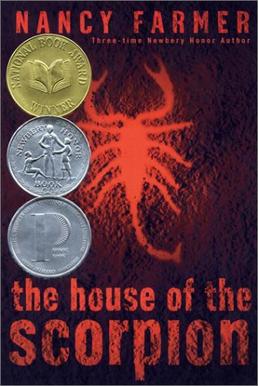
The House of the Scorpions revolves around the main character, Matt Alacran, as he develops and matures as a person from childhood, to a teenager, and finally, to an adult. But unlike other people, Matt is a clone who was only taken care of simply because the ruler of Opium, a fictional country between Mexico and the United States, would be subjected to health problems and would need the clone’s organs transplanted onto him to survive. Once Matt is found out to be a clone, the people around him treat him as if he was a monster and avoided him if it was unnecessary. Matt also goes through a state of denial and tries to convince himself that he is more than a clone.

Clones or replicas definitely present a moral issue if we were to somehow develop the means to do so in the future. Identity thefts, “racism” against clones, and potential killings of the original are all factors that could occur if clones were to happen in the future. Though it can see a medical purpose in terms of having the same blood types and organs as their originals, the “racism” against clones, and even against their originals would be a predominant effect if clones were to be developed for human beings. I would personally not support the idea of clones in the future; it’s okay for a movie or novel plot, but apply it to real life, and we may have an issue or issues that may not go away for centuries. It would be similar to the black struggle that we had about a century ago; even today, there is still some lingering stereotypes and racism present. The Ku Klux Klan still survives even to this day, proof that issues like racism are hard to kill and completely eliminate once introduced.

Nancy Farmer, through this novel, wanted to show how vulnerable people are when it comes to actually developing elements that people would normally see on sci-fi films. Exemplified by the people in the novel who just view Matt as a monster, most people in today’s society cannot deal with the supernatural or weird elements. Fancy technology makes them go “Wow!”, but in comparison, clones, ghosts, or really anything disconfigured in terms of biology freaks people out. After reading the work, Farmer is trying to get us to be more accepting of all the ideas, opinions, and even people out there in the world. Just because someone is different or doesn’t conform to today’s society doesn’t mean that he or she is evil and deserves to be shunned. The novel seems to imply that today’s society still has not grown accustomed to the brand new ideas lurking around there; tradition is still highly valued and anything different gets tossed in the trash. All of this is seen through the perspective of the main character of the novel; Farmer develops an emotional bond between her readers and the main character by being along with him through the entirety of his life. That way, her readers can understand and sympathize with him, which then leads to acknowledging one of the messages in the book.

Ar Tonelico - Cosmosphere Technology


In this scene from Ar Tonelico Qoga: Knell of Ar Ciel, Teppo, a “plug-in” for the Cosmosphere, analyzes and scans the soulspace, or the mind, of one of the main characters here, Finnel. After finishing the scan, Teppo reports back with the list of problems and suggested solutions for the main character, Aoto, to take.

The whole situation resembles that of handling a computer. Teppo represents something along the lines of maybe an anti-virus scanner, Finnel represents the computer itself, and Aoto represents the user. The only major difference is that the “computer” is an organic living being modeled after humans, has emotions, and is able to personally react and respond to situations. The Cosmosphere, or the soulspace, is the term the game uses to label Finnel’s mind, or going back to the computer analogy, the Cosmosphere would represent the hidden and protected files that normally, users shouldn’t touch if they want their computer to continue functioning. The Cosmosphere acts as a way for divers, or the users, to go inside the minds of their “computers” and help fix their emotional problems so that they can perform better. In a way, this also applies to the computer analogy as well; someone well-versed in modifying computer data can help boost performance speed and other functions of the computer.

If we had the ability to “dive” into the minds of people, it would be a cooler way of developing romantic relationships. Instead of say, going onto a date to the movies or eating out, one could dive into the mind of the other person and understand each other and resolve each other’s personal problems. At the same time… there would probably be a lot of relationship problems, and I would predict the marriage rate to plummet. I think a lot of people wouldn’t be able to handle the personal problems of their potential spouse, and they would just end up breaking down and breaking up with the person if they find a personal flaw while in their minds. As they go deeper into their minds, they would find a large number of serious problems that they would have to deal with, and if they can’t deal with it, then the relationship gets broken. There may be a personal issue if we allowed anyone to go inside each other’s mind, but if we modeled it after the Cosmosphere concept in this game, the person being dived into gets to reject anyone who they don’t want messing around in their minds. If the couple does survive being able to handle each other’s problems, then I think that would qualify as “true love.”

With the Cosmosphere concept in mind, I think the writers for this game probably wanted for the audience to think about the relationships that they have. Are people really friends with each other if they run away from each other’s problems and don’t help each other in some way with the problems? Are people really in love if they don’t care about each other’s problems? One of the messages, I think, is that to develop a genuine and strong bond, one needs to also genuinely care about other people’s problems, and help them out, whether it’s physically, or emotionally, like an encouragement. The way the game presents this message is actually through repetition. The player gets to explore other Cosmospheres other than Finnel’s, and resolve their personal issues and problems.

The possible future we could develop from this game obviously shows that in the present day, technology will continue to evolve as time passes on. But it also presents an idea of shallowness in today’s society that we see. Sometimes, we see people marry for money, or marry for beauty. Even in movies like Twilight, the love is irrational and not really for the right reasons. Real love is much more than that; it’s about confronting each other’s problems and supporting each other through thick and thin. On a lighter note... we are victims of cute and fluffy objects, e.g. Teppo.