“The beast emerged slowly, reaching out to grip the edge of the box with tiny four-fingered hands. Its fur was damp, and its huge eyes blinked in the glow of the heaters. It looked about attentively, twitching as it pulled itself farther from the broken egg… At least it was clear enough that the creature didn’t eat humans. It was far too small for that, and too… appealing, even with its strange excess of skin. Somehow the large eyes seemed wise and sad. Alek found himself wanting to pick the animal up and comfort it… It was strange, how the creature didn’t give him the same uneasy feeling as other Darwinist creations. It was too small and sleepy-looking, and gave off an air of preternatural calm” (129-131).
As Alek is about to escape from the Leviathan, he notices that one of the eggs of Dr. Barlow is about to hatch. To Alek, the beast seems to captivate him; unlike the other Darwinist beasts, this one seemed to give off emotions like sadness from its countenance. He could tell it was harmless, and it was a creature that made him feel calm, despite his situation and him being a Clanker and therefore being in direct opposition to manmade creations such as this creature.
Based on the author’s illustration of the creature, it reminds me of a monkey and lemur hybrid; it doesn’t striking look to be a creature that would provide Alek with a sense of calm and tranquility, but maybe that’s just me. Yet, this creature is supposed to have the power to accomplish Dr. Barlow’s mission of making the Ottomans allies to the Darwinist nations. So, it’s a cute and adorable creature by the book’s standard, and it possesses a great amount of power to change the tides of the war. It’s definitely ironic and somewhat of a cliché, but it’ll be interesting to see Westerfield flesh this out.
The way that Westerfield describes the beast as “appealing” and the way that it gives off a tranquil aura once again support the idea that not all Darwinist creations are meant for warfare. Well, actually, that’s not completely true; this creature supposedly has the power to change the tides of war, but besides that, its abilities and appearance do not denote anything dangerous about it. Being a newborn baby, or having its image being described as being similar to that of a newborn baby, helps to create this innocence image of the beast and therefore support the idea that Darwinist creations can be majestic in their own right.
As a reference to one of my earlier posts, this cute little creature who can’t hurt a fly supports the idea that our current society is falling victim to “cute, little, fluffy” objects and animals and are buying into this image and appearance. Animal breeders are looking to create animals that will look appealing; toy makers are pushing out products that have this “cute” image, like Hello Kitty or Barbie dolls.
Sunday, January 15, 2012

Behemoth - The "Behemoth"
“Deryn saw now what the walker’s trunk was for. As the machine lumbered through the crowd, its trunk swept gracefully from side to side, nudging pedestrians out of the way. The howdah pilot’s fingers moved nimbly on the controls; he pushed carts aside, and even rescued a child’s fallen toy from being crushed by the walker’s giant feet” (109).
In this scene, onboard the “Behemoth”, or otherwise known as the elephantine walker viewed earlier in the novel, Deryn witnesses the walker in action and how it functions using its different body parts. The Behemoth uses its trunk primarily to sweep people away lightly and to avoid crushing people and objects with its giant feet.
Once again, having a “Behemoth” in real life would be pretty amazing; I wouldn’t mind taking a “Behemoth” to school for a ride. Granted, the traffic may be horrible if everyone decides to take a Behemoth, but regardless, who wouldn’t want a giant mechanical elephant that you can control and move about? Walking and driving would become a thing of the past with Behemoths, and unlike in video games, these Behemoths aren’t vicious creatures with sharp claws, but rather elephants that people can ride on.
All joking aside, once again, Westerfield is building up the idea that Darwinist creations are majestic in nature with this passage. The Behemoth, despite its name and negative connotation of it being a mindless beast and creature, is actually an elephant whose trunk is described as a way to gently brush people and objects aside to keep them from being crushed. It’s definitely powerful, that’s no doubt, but the way Westerfield describes the motion of the trunk pushing people aside gives it the impression that it is a gentle giant. It’s powerful, but it has a sense of delicacy unseen in savage beasts and creatures, or even the Behemoth by its normal definitions in today’s society. Rescuing a child’s toy also tugs at the heartstrings as well; it’s an appeal to the emotional side of the readers to get them to support the Behemoth and feel at ease with its majestic presence and the idea that both Darwinist and Clanker ideas can come together and that each creation doesn’t have to be about war but rather be about efficiency.
The Behemoth and the functions of its trunk to sweep people away definitely shows that today’s society has an emphasis on convenience like in the last post, but rather than using animals, society is just making pleasing to the eye creations that are convenient to us, like the iPhone. With society focusing so much on convenience and energy conservation, the creation of the Behemoth in reality could very well happen with potential hydraulic power and of course, time.
In this scene, onboard the “Behemoth”, or otherwise known as the elephantine walker viewed earlier in the novel, Deryn witnesses the walker in action and how it functions using its different body parts. The Behemoth uses its trunk primarily to sweep people away lightly and to avoid crushing people and objects with its giant feet.
Once again, having a “Behemoth” in real life would be pretty amazing; I wouldn’t mind taking a “Behemoth” to school for a ride. Granted, the traffic may be horrible if everyone decides to take a Behemoth, but regardless, who wouldn’t want a giant mechanical elephant that you can control and move about? Walking and driving would become a thing of the past with Behemoths, and unlike in video games, these Behemoths aren’t vicious creatures with sharp claws, but rather elephants that people can ride on.
All joking aside, once again, Westerfield is building up the idea that Darwinist creations are majestic in nature with this passage. The Behemoth, despite its name and negative connotation of it being a mindless beast and creature, is actually an elephant whose trunk is described as a way to gently brush people and objects aside to keep them from being crushed. It’s definitely powerful, that’s no doubt, but the way Westerfield describes the motion of the trunk pushing people aside gives it the impression that it is a gentle giant. It’s powerful, but it has a sense of delicacy unseen in savage beasts and creatures, or even the Behemoth by its normal definitions in today’s society. Rescuing a child’s toy also tugs at the heartstrings as well; it’s an appeal to the emotional side of the readers to get them to support the Behemoth and feel at ease with its majestic presence and the idea that both Darwinist and Clanker ideas can come together and that each creation doesn’t have to be about war but rather be about efficiency.
The Behemoth and the functions of its trunk to sweep people away definitely shows that today’s society has an emphasis on convenience like in the last post, but rather than using animals, society is just making pleasing to the eye creations that are convenient to us, like the iPhone. With society focusing so much on convenience and energy conservation, the creation of the Behemoth in reality could very well happen with potential hydraulic power and of course, time.
Behemoth - Elephantines
“I didn’t know Clanker countries had elephantines!” Newkirk cried.
“That’s no beastie,” Deryn said. “It’s a barking walker.”
The machine lumbered forward on huge legs, its tusks swaying back and forth as it moved. Four pilots in blue uniforms sat on saddles that stuck out from its haunches, one pilot working the controls for each leg. A mechanical trunk, divided into a dozen metal segments, swept slowly back and forth, like a sleeping cat’s tail…
“Diplomacy is all about symbols,” Dr. Barlow said. “Elephants signify royalty and power; according to legend an elephant divined the prophet Mohammed’s birth. The sultan’s own war machines are made in this same shape” (101-102).
In this scene, the crew aboard the Leviathan witnesses an elephantine that has come to pick them up and escort them in Istanbul or Constantinople. However, upon closer inspection, it was not a Darwinist creation, but a Clanker creation modeled in the same fashion as an elephant with the same body parts with a pilot controlling each body part. Dr. Barlow explains to the crew that this walker was modeled after an elephant for it symbolically represented.
I think it’s neat that the Clankers have developed their machinery after Darwinist creations; there’s definitely a sense of synergy between the two different types of technology used within the novel and it does give the impression that the two can coexist with each other rather than pit each other’s technology against one another. Modeling animals with technology has already been done in real life too; we have cat-shaped alarm clocks, and teddy bear cameras, so having this kind of cooperation in the novel seems reasonable.
In a more serious sense, modeling Darwinist creatures with Clanker technology is a way of paying tribute to the power and beauty of such animals like the elephant; it’s nothing like in reality where this is really just used for the “cuteness” appeal to children who don’t know any better. This passage reveals how such modeling is a way of symbolism and diplomacy and shows the readers how much animals are revered in this world, even by the opposition, who goes so far as to even model their machinery and creations after the Darwinist creations. Vivid description from the author of the elephantine walker, as well as Dr. Barlow’s description, helps establish this idea to the readers that animals are revered as symbols of the world. This sort of idea does counteract the idea established in previous posts that the Darwinists have the potential to create dangerous creatures; they also have the potential to create majestic creatures of symbolic importance as well to the world.
While advertisers and marketers in the present day continue to push out toys and products modeled after animals to target the younger audience, this book seems to indicate that we should be taking a different approach. Instead of using these models for entertainment purposes for younger audiences, there lies the possibility of using animal-modeled technology for convenience purposes or travel purposes; imagine being able to travel on an elephant across a river…
“That’s no beastie,” Deryn said. “It’s a barking walker.”
The machine lumbered forward on huge legs, its tusks swaying back and forth as it moved. Four pilots in blue uniforms sat on saddles that stuck out from its haunches, one pilot working the controls for each leg. A mechanical trunk, divided into a dozen metal segments, swept slowly back and forth, like a sleeping cat’s tail…
“Diplomacy is all about symbols,” Dr. Barlow said. “Elephants signify royalty and power; according to legend an elephant divined the prophet Mohammed’s birth. The sultan’s own war machines are made in this same shape” (101-102).
In this scene, the crew aboard the Leviathan witnesses an elephantine that has come to pick them up and escort them in Istanbul or Constantinople. However, upon closer inspection, it was not a Darwinist creation, but a Clanker creation modeled in the same fashion as an elephant with the same body parts with a pilot controlling each body part. Dr. Barlow explains to the crew that this walker was modeled after an elephant for it symbolically represented.
I think it’s neat that the Clankers have developed their machinery after Darwinist creations; there’s definitely a sense of synergy between the two different types of technology used within the novel and it does give the impression that the two can coexist with each other rather than pit each other’s technology against one another. Modeling animals with technology has already been done in real life too; we have cat-shaped alarm clocks, and teddy bear cameras, so having this kind of cooperation in the novel seems reasonable.
In a more serious sense, modeling Darwinist creatures with Clanker technology is a way of paying tribute to the power and beauty of such animals like the elephant; it’s nothing like in reality where this is really just used for the “cuteness” appeal to children who don’t know any better. This passage reveals how such modeling is a way of symbolism and diplomacy and shows the readers how much animals are revered in this world, even by the opposition, who goes so far as to even model their machinery and creations after the Darwinist creations. Vivid description from the author of the elephantine walker, as well as Dr. Barlow’s description, helps establish this idea to the readers that animals are revered as symbols of the world. This sort of idea does counteract the idea established in previous posts that the Darwinists have the potential to create dangerous creatures; they also have the potential to create majestic creatures of symbolic importance as well to the world.
While advertisers and marketers in the present day continue to push out toys and products modeled after animals to target the younger audience, this book seems to indicate that we should be taking a different approach. Instead of using these models for entertainment purposes for younger audiences, there lies the possibility of using animal-modeled technology for convenience purposes or travel purposes; imagine being able to travel on an elephant across a river…
Behemoth - "Telescopes"
The space was crowded by what looked like a mismatched pair of telescopes pointed down at the sea.
“Is that a weapon?” he asked.
“No. The fat one is a reconnaissance camera,” Dylan said. “And the wee one’s a sight for aerial bombs and navigation. But they’re useless at night, so it’ll be private enough” (89).
Deryn is escorting Alek to a place where he won’t be caught. Along the way, Alek notices Darwinist creatures that looked like a mismatched pair of telescopes, one of them being large, while the other one is small by comparison. Deryn explains to him their functions as a camera and a detector for aerial attacks and navigator, respectively. However, despite their functions, she eases his worries by telling him that they’re useless at night so they can sneak past their watchful eyes.
I’m not too sure on why exactly the Darwinists would choose the “fat one” to be the reconnaissance camera for the Leviathan while the “wee one” becomes the detector for navigation and aerial bombs. It feels as if the two roles should be reversed; the bulky one should be the detector for the navigation and for the aerial attacks due to its size and stature, possibly allowing it to detect enemy attacks over height obstacles. Likewise, the small creature should be the camera; its small stature allows it to remain undetected and it doesn’t need to peer over great distances to detect any suspicious behaviors or enemies onboard the Leviathan. Regardless, both seem to perform useful functions, barring the fact that they don’t have night vision, and can be applied to reality as well.
While this passage does seem to offer more of an insight into the creatures that the Darwinists created, it also begs the question of exactly what kind of creatures they are capable of creating with their technology. Throughout the books, the readers have seen flechette bats, message lizards, the Leviathan itself, and now these animals that operate as surveillance creatures. While not completely threatening, the passage seems to raise the question to the readers about potential creatures that they could see in the future from these Darwinists, maybe a creature somewhere along the lines of Godzilla or even a virus that’s tangible and has a physical presence. Looking back on the previous posts and pages, Westerfield builds up this suspicion throughout the chapters and pages by constantly referring back to these creatures and their capabilities and functions; it wouldn’t be surprising to see something threatening in the future from this group of people.
All of these creatures that are suddenly being discussed about and being worried about does bring up a moral and ethical point if these creatures are really meant to be created. In reality, we have PETA who, although doesn’t exactly make the smartest decisions when it comes to animal safety and protection, advocates for the safety of animals against immoral treatments. It brings up a good question in today’s society: is experimenting with animals to develop them truly immoral?
“Is that a weapon?” he asked.
“No. The fat one is a reconnaissance camera,” Dylan said. “And the wee one’s a sight for aerial bombs and navigation. But they’re useless at night, so it’ll be private enough” (89).
Deryn is escorting Alek to a place where he won’t be caught. Along the way, Alek notices Darwinist creatures that looked like a mismatched pair of telescopes, one of them being large, while the other one is small by comparison. Deryn explains to him their functions as a camera and a detector for aerial attacks and navigator, respectively. However, despite their functions, she eases his worries by telling him that they’re useless at night so they can sneak past their watchful eyes.
I’m not too sure on why exactly the Darwinists would choose the “fat one” to be the reconnaissance camera for the Leviathan while the “wee one” becomes the detector for navigation and aerial bombs. It feels as if the two roles should be reversed; the bulky one should be the detector for the navigation and for the aerial attacks due to its size and stature, possibly allowing it to detect enemy attacks over height obstacles. Likewise, the small creature should be the camera; its small stature allows it to remain undetected and it doesn’t need to peer over great distances to detect any suspicious behaviors or enemies onboard the Leviathan. Regardless, both seem to perform useful functions, barring the fact that they don’t have night vision, and can be applied to reality as well.
While this passage does seem to offer more of an insight into the creatures that the Darwinists created, it also begs the question of exactly what kind of creatures they are capable of creating with their technology. Throughout the books, the readers have seen flechette bats, message lizards, the Leviathan itself, and now these animals that operate as surveillance creatures. While not completely threatening, the passage seems to raise the question to the readers about potential creatures that they could see in the future from these Darwinists, maybe a creature somewhere along the lines of Godzilla or even a virus that’s tangible and has a physical presence. Looking back on the previous posts and pages, Westerfield builds up this suspicion throughout the chapters and pages by constantly referring back to these creatures and their capabilities and functions; it wouldn’t be surprising to see something threatening in the future from this group of people.
All of these creatures that are suddenly being discussed about and being worried about does bring up a moral and ethical point if these creatures are really meant to be created. In reality, we have PETA who, although doesn’t exactly make the smartest decisions when it comes to animal safety and protection, advocates for the safety of animals against immoral treatments. It brings up a good question in today’s society: is experimenting with animals to develop them truly immoral?
Behemoth - Message Lizard Room
“What is this place?” he breathed.
“It’s the barking lizard room, isn’t it?” Dylan whispered. “It’s where Dr. Erasmus takes care of the beasties.”
Alek swallowed, his eyes falling on a table where a dissected lizard lay pinned. Then he saw that the ceiling was covered with the gaping mouths of message tubes, tangled like railroad tracks at a station, “And it’s a sort of junction too, isn’t it?”
“Aye. Dr. Erasmus is in charge of all that palaver – origin and destination tags, emergency alerts, clearing up traffic jams” (83).
In this scene, Alek is trying to find an escape route due to the realization that the Clankers will be thrown in prison once their usefulness has been outlived. However, Alek gets lost and stumbles into the message lizard room where he meets up with Dylan accidently. Dylan, or Deryn, explains to him that the room that they are in is the lizard room where Dr. Erasmus operates and dissects the lizards for research purposes. In addition to that, it is also a room meant for relaying and delivering messages carried out by these lizards.
The lizard room that they’re in is similar to that of an intercom room, only the lizards operate more stealthily, while the intercom is just a large booming noise over the entire premise. I would actually prefer to have a lizard room in the context of school scenarios. The lizards can deliver specific messages to every homeroom rather than have every single message be read out to the entire school. Topics like Junior Variety practices could be delivered to junior homerooms only, while topics like senior fundraisers could be delivered to senior homerooms likewise. Of course, the dissecting part would have to be left out of the room, but other than that, it seems like a solid idea, barring fears of lizard creatures.
Going back to the previous post, this definitely seems to support Count Volger’s suspicion that the message lizards can be used as spies all around the Leviathan. In the context of the story, this passage seems to be meant for raising the question of the overall credibility of the Darwinists aboard the Leviathan, except for Deryn, who seems to be the only one who truly supports Alek, and it goes back once again to the whole saying of never judging a book by its cover. The passage makes the audience doubt even more the plans of the Darwinists for the Clankers and question what fate they have in mind for the Clankers once they have outlived their usefulness.
In a sense, this passage seems to be an indicator of how paranoid we’ve become as a society of other people. We feel we need to interfere and know about people’s lives, and thus the invention of Twitter and reality TV shows. Yet, at the same time, it can also be advocating the idea that instead of developing our machinery and consuming valuable energy resources here in the present day, we can devote our research time to evolving other species so that they can be used to benefit society and fulfill new purposes otherwise done by machinery.
“It’s the barking lizard room, isn’t it?” Dylan whispered. “It’s where Dr. Erasmus takes care of the beasties.”
Alek swallowed, his eyes falling on a table where a dissected lizard lay pinned. Then he saw that the ceiling was covered with the gaping mouths of message tubes, tangled like railroad tracks at a station, “And it’s a sort of junction too, isn’t it?”
“Aye. Dr. Erasmus is in charge of all that palaver – origin and destination tags, emergency alerts, clearing up traffic jams” (83).
In this scene, Alek is trying to find an escape route due to the realization that the Clankers will be thrown in prison once their usefulness has been outlived. However, Alek gets lost and stumbles into the message lizard room where he meets up with Dylan accidently. Dylan, or Deryn, explains to him that the room that they are in is the lizard room where Dr. Erasmus operates and dissects the lizards for research purposes. In addition to that, it is also a room meant for relaying and delivering messages carried out by these lizards.
The lizard room that they’re in is similar to that of an intercom room, only the lizards operate more stealthily, while the intercom is just a large booming noise over the entire premise. I would actually prefer to have a lizard room in the context of school scenarios. The lizards can deliver specific messages to every homeroom rather than have every single message be read out to the entire school. Topics like Junior Variety practices could be delivered to junior homerooms only, while topics like senior fundraisers could be delivered to senior homerooms likewise. Of course, the dissecting part would have to be left out of the room, but other than that, it seems like a solid idea, barring fears of lizard creatures.
Going back to the previous post, this definitely seems to support Count Volger’s suspicion that the message lizards can be used as spies all around the Leviathan. In the context of the story, this passage seems to be meant for raising the question of the overall credibility of the Darwinists aboard the Leviathan, except for Deryn, who seems to be the only one who truly supports Alek, and it goes back once again to the whole saying of never judging a book by its cover. The passage makes the audience doubt even more the plans of the Darwinists for the Clankers and question what fate they have in mind for the Clankers once they have outlived their usefulness.
In a sense, this passage seems to be an indicator of how paranoid we’ve become as a society of other people. We feel we need to interfere and know about people’s lives, and thus the invention of Twitter and reality TV shows. Yet, at the same time, it can also be advocating the idea that instead of developing our machinery and consuming valuable energy resources here in the present day, we can devote our research time to evolving other species so that they can be used to benefit society and fulfill new purposes otherwise done by machinery.
Behemoth - Tazza
“What Tazza, talk?” Deryn stifled a laugh. “He’s no message lizard. He’s a natural beastie, a thylacine from Tasmania. Dr. Barlow has him as a traveling companion though, as you can see, he’s mostly my responsibility. Anyway, I’ve got a message from…” (57).
In this passage, Deryn goes to Count Volger to discuss with him about Alec’s secret information. Initially, Volger doubts Deryn’s credibility, believing in the possibility that she could be a spy, since the message lizards themselves could pick up messages and eavesdrop on their conversations. He then begins to believe that Tazza, the pet thylacine that Dr. Barlow has, can also be an eavesdropper, having the ability to pick up what their conversation is about.
I find it a bit weird that the Darwinists would even refer to their natural creatures as “beasties”; the word “beastie” doesn’t have a very good connotation to it. It makes me think of a vicious animal waiting for the right moment to tear someone apart. That aside, the thylacine reminds me of something like a pet dog, in terms of modern parallels. It keeps people company, and it seems to be Dr. Barlow’s most trusted friend, similar to the saying that says that dogs are man’s best friends.
Westerfield seems to be making a point in this passage about the cliché saying, “Never judge a book by its cover.” Count Volger suspects that even a natural creature such as Tazza could have abilities like that of the other Darwinist creations, despite its friendly appearance. Of course, Deryn denies Tazza’s speculated capabilities, but Westerfield draws upon the credibility of Volger to make the audience believe and wonder what exactly Tazza is besides being told that he is a “thylacine from Tasmania”. Even though he has went behind the Alek’s back in the past, his readers can’t deny the fact that he does possess a great amount of knowledge on par with Dr. Barlow, and maybe he could be onto something with Tazza being potentially a stealthy creature or a creature with an unknown purpose, like the eggs that Dr. Barlow is hatching.
The scenario presented in this passage does make us reflect on how in the present-day, animals can be trained to literally do almost everything. We have cats being able to play the piano, dogs that can sniff out drugs or become rescuers, and so on. Soon, maybe we can develop our own Darwinist creations, albeit, not on the scale of those in the book, but still, breeding our animals and training them to do human activities are just steps to making our own creations.
In this passage, Deryn goes to Count Volger to discuss with him about Alec’s secret information. Initially, Volger doubts Deryn’s credibility, believing in the possibility that she could be a spy, since the message lizards themselves could pick up messages and eavesdrop on their conversations. He then begins to believe that Tazza, the pet thylacine that Dr. Barlow has, can also be an eavesdropper, having the ability to pick up what their conversation is about.
I find it a bit weird that the Darwinists would even refer to their natural creatures as “beasties”; the word “beastie” doesn’t have a very good connotation to it. It makes me think of a vicious animal waiting for the right moment to tear someone apart. That aside, the thylacine reminds me of something like a pet dog, in terms of modern parallels. It keeps people company, and it seems to be Dr. Barlow’s most trusted friend, similar to the saying that says that dogs are man’s best friends.
Westerfield seems to be making a point in this passage about the cliché saying, “Never judge a book by its cover.” Count Volger suspects that even a natural creature such as Tazza could have abilities like that of the other Darwinist creations, despite its friendly appearance. Of course, Deryn denies Tazza’s speculated capabilities, but Westerfield draws upon the credibility of Volger to make the audience believe and wonder what exactly Tazza is besides being told that he is a “thylacine from Tasmania”. Even though he has went behind the Alek’s back in the past, his readers can’t deny the fact that he does possess a great amount of knowledge on par with Dr. Barlow, and maybe he could be onto something with Tazza being potentially a stealthy creature or a creature with an unknown purpose, like the eggs that Dr. Barlow is hatching.
The scenario presented in this passage does make us reflect on how in the present-day, animals can be trained to literally do almost everything. We have cats being able to play the piano, dogs that can sniff out drugs or become rescuers, and so on. Soon, maybe we can develop our own Darwinist creations, albeit, not on the scale of those in the book, but still, breeding our animals and training them to do human activities are just steps to making our own creations.
Sunday, December 18, 2011
Leviathan - The Huxley
An airbeast was inside: a Huxley ascender, its tentacles in the grips of a dozen ground men. The beast pulsed and trembled as they drew it gently out, setting its translucent gasbag shimmering with the red light of the rising sun.
"A medusa," gasped the boy next to her.
Deryn nodded. This was the first hydrogen breather ever fabricated, nothing like the giant living airships of today, with their gondolas, engines, and observation decks.
The Huxley was made from the life chains of medusae - jellyfish and other venomous sea creatures - and was practically as dangerous. One wrong puff of wind could spook a Huxley, sending it diving for the ground like a bird headed for worms. The creatures' fishy guts could survive almost any fall, but their human passengers were rarely so lucky (Westerfield, 30-31).
Deryn is applying as a soldier for the army. Part of the prerequisites was “air sense”, the ability to travel in flight and know what to do if dire situations arise all the while keeping a cool and level head. For this test, candidates must fly using a Huxley, an airbeast that looks like a medusa with its tentacles.
I think personally having a Huxley as a pet would actually be enjoyable; I could use it to relieve my stress after a long day of work. That is of course barring the danger involved with flying a Huxley. Though a Huxley, design-wise, would not be very popular with the public. Like I mentioned before, we as a society unfortunately like cute and fluffy objects and animals. That’s why brands like Hello Kitty are so popular. A Huxley on the other hand has tentacles, is slimy, and is overall displeasing to the eye. Not to mention the fact that the Huxley has to put tentacles over the person in order to fly, which may also put some people off.
The passage about the Huxley seems to inspire both awe and fear into the audience. This is the first instance in the novel about a Darwinist creature; it’s interesting in that it’s a combination of jellyfish species and can fly, yet, it is also sort of frightening that it’s essentially a tentacle monster that can fly someone. The imagery, as well as the description of the Huxley work together to provide a sense of awe about this unique creature but also a sense of fear from the dangers of falling and the idea of being surrounded by slimy tentacles. The audience does get this sense of foreboding from the monster itself, but the uniqueness of the creature serves to instill more interest and awe than it is fear.
The idea of the fabrication of a Huxley seems to suggest that society today isn’t afraid to venture into new unknowns, even if that unknown is a tentacle monster. Even the Leviathan is proof of bold, large, and new innovations of today.
"A medusa," gasped the boy next to her.
Deryn nodded. This was the first hydrogen breather ever fabricated, nothing like the giant living airships of today, with their gondolas, engines, and observation decks.
The Huxley was made from the life chains of medusae - jellyfish and other venomous sea creatures - and was practically as dangerous. One wrong puff of wind could spook a Huxley, sending it diving for the ground like a bird headed for worms. The creatures' fishy guts could survive almost any fall, but their human passengers were rarely so lucky (Westerfield, 30-31).
Deryn is applying as a soldier for the army. Part of the prerequisites was “air sense”, the ability to travel in flight and know what to do if dire situations arise all the while keeping a cool and level head. For this test, candidates must fly using a Huxley, an airbeast that looks like a medusa with its tentacles.
I think personally having a Huxley as a pet would actually be enjoyable; I could use it to relieve my stress after a long day of work. That is of course barring the danger involved with flying a Huxley. Though a Huxley, design-wise, would not be very popular with the public. Like I mentioned before, we as a society unfortunately like cute and fluffy objects and animals. That’s why brands like Hello Kitty are so popular. A Huxley on the other hand has tentacles, is slimy, and is overall displeasing to the eye. Not to mention the fact that the Huxley has to put tentacles over the person in order to fly, which may also put some people off.
The passage about the Huxley seems to inspire both awe and fear into the audience. This is the first instance in the novel about a Darwinist creature; it’s interesting in that it’s a combination of jellyfish species and can fly, yet, it is also sort of frightening that it’s essentially a tentacle monster that can fly someone. The imagery, as well as the description of the Huxley work together to provide a sense of awe about this unique creature but also a sense of fear from the dangers of falling and the idea of being surrounded by slimy tentacles. The audience does get this sense of foreboding from the monster itself, but the uniqueness of the creature serves to instill more interest and awe than it is fear.
The idea of the fabrication of a Huxley seems to suggest that society today isn’t afraid to venture into new unknowns, even if that unknown is a tentacle monster. Even the Leviathan is proof of bold, large, and new innovations of today.
Leviathan - The Bats
"Well, don't worry," Alek said, clapping a hand on Dylan's shoulder. "The Stormwalker can carry all the food your airbeast needs. Though I can't see how one creature could eat all this."
"Don't be daft. The Leviathan isn't one creature," Dylan said. "It's a whole tangle of beasties - what they call an ecosystem."
Alek nodded slowly. "Did I hear Dr. Barlow say something about bats?"
"Aye, the flechette bats. You should see those wee beasties at work."
"Flechette? Like 'dart' in French?"
"That sounds right," Dylan said. "The bats gobble up these metal spikes, then release them over the enemy."
"They eat spikes," Alek said slowly. "And then ... release them?"
Dylan stifled a laugh. "Aye, in the usual way."
Alek blinked. The boy couldn't possibly be saying what Alek thought he was. Perhaps it was another of his peculiar jokes.
"Well, I'm glad we're at peace, so your bats won't be, um ... releasing their flechettes on us." (Westerfield, 328)
To help save the Leviathan, Alek offers Dylan/Deryn caches of food and supplies back at his family’s castle. They discuss how to transport the food back to the Leviathan, as well as the Leviathan’s diet and the bats used for warfare that the Leviathan has.
If bats developed the ability to eat spikes and then used them as projectile weaponry, I think bats would go on to be potentially one of the most dangerous, if not the dangerous, animal on the planet. It is a bit worrisome if some animals developed some dangerous self-protection habits. In the future, we could have worms spitting out corrosive acid and burning through our skin, or cats with the ability to extend their claws, or birds learning how to spit out seeds at predators. More people would probably be afraid of animals at this point, and probably more pet laws will be put into place. The future of pets would probably be dark and grim if they learned to use these abilities against humans…
The passage itself makes a clear point not to underestimate animals at all; they can be cunning and dangerous beings (even if they aren’t genetically altered like they are here). Westerfield ironically makes this point through comedic effect; in this scene, there is clearly an awkward, yet humorous, moment between Alek and Dylan concerning the flechette bats. The use of awkward pauses done by ellipses, as well as the awkward phrasing of Alek’s words, contributes to this sense of both fear and light-heartedness. It’s not exactly funny about the possibility of getting hit with metal spikes coming out of a bat’s mouth, but Alek’s uneasiness about the whole development dispels part of the fear with humor. Besides making the readers chuckle a bit, the passage itself does astonish us, making us wonder what sort of other animals introduced in the novel will have weird yet powerful abilities.
Developing bats with the ability to eat spikes seems to indicate that our society has a strange knack for developing weird yet potentially useful objects. Having this sort of innovation isn’t bad; if we as society lived within the lines, barely any inventions would get created. Though… the practicality of developing bats out of all animals to be the ones to shoot out spikes remains to be questioned. At least the Leviathan is practical; it has the size and power to both fly a fast rate and shoot out projectiles to defend itself against enemies.
"Don't be daft. The Leviathan isn't one creature," Dylan said. "It's a whole tangle of beasties - what they call an ecosystem."
Alek nodded slowly. "Did I hear Dr. Barlow say something about bats?"
"Aye, the flechette bats. You should see those wee beasties at work."
"Flechette? Like 'dart' in French?"
"That sounds right," Dylan said. "The bats gobble up these metal spikes, then release them over the enemy."
"They eat spikes," Alek said slowly. "And then ... release them?"
Dylan stifled a laugh. "Aye, in the usual way."
Alek blinked. The boy couldn't possibly be saying what Alek thought he was. Perhaps it was another of his peculiar jokes.
"Well, I'm glad we're at peace, so your bats won't be, um ... releasing their flechettes on us." (Westerfield, 328)
To help save the Leviathan, Alek offers Dylan/Deryn caches of food and supplies back at his family’s castle. They discuss how to transport the food back to the Leviathan, as well as the Leviathan’s diet and the bats used for warfare that the Leviathan has.
If bats developed the ability to eat spikes and then used them as projectile weaponry, I think bats would go on to be potentially one of the most dangerous, if not the dangerous, animal on the planet. It is a bit worrisome if some animals developed some dangerous self-protection habits. In the future, we could have worms spitting out corrosive acid and burning through our skin, or cats with the ability to extend their claws, or birds learning how to spit out seeds at predators. More people would probably be afraid of animals at this point, and probably more pet laws will be put into place. The future of pets would probably be dark and grim if they learned to use these abilities against humans…
The passage itself makes a clear point not to underestimate animals at all; they can be cunning and dangerous beings (even if they aren’t genetically altered like they are here). Westerfield ironically makes this point through comedic effect; in this scene, there is clearly an awkward, yet humorous, moment between Alek and Dylan concerning the flechette bats. The use of awkward pauses done by ellipses, as well as the awkward phrasing of Alek’s words, contributes to this sense of both fear and light-heartedness. It’s not exactly funny about the possibility of getting hit with metal spikes coming out of a bat’s mouth, but Alek’s uneasiness about the whole development dispels part of the fear with humor. Besides making the readers chuckle a bit, the passage itself does astonish us, making us wonder what sort of other animals introduced in the novel will have weird yet powerful abilities.
Developing bats with the ability to eat spikes seems to indicate that our society has a strange knack for developing weird yet potentially useful objects. Having this sort of innovation isn’t bad; if we as society lived within the lines, barely any inventions would get created. Though… the practicality of developing bats out of all animals to be the ones to shoot out spikes remains to be questioned. At least the Leviathan is practical; it has the size and power to both fly a fast rate and shoot out projectiles to defend itself against enemies.
Leviathan - Darwinists vs. Clankers
The airship lay in a dark lump on the glacier's featureless white. It looked smaller now, as if slowly deflating. No fires or lamps were visible, just the strange glow he'd noticed earlier. Tiny pinpricks of light moved in the wreckage, like green fireflies buzzing about the giant creature's wounds.
Alek shivered. He'd heard awful stories about the Darwinists' creations: half-breeds of tigers and wolves, mythological monsters brought to life, animals that spoke and even reasoned like humans, but had no souls. He'd been told that when godless beasts were created, the spirits of demons occupied them - pure evil given flesh (Westerfield, 230).
The Leviathan had crashed into a desolate wasteland high up in the mountains, and Alek, the main protagonist, goes to check out the crash, worrying that there may be people who may be injured from the crash or need food. Once he got close enough to the site, he realized that the Leviathan wasn’t an airship, but rather a living being, and reflected upon all the facts that he was told about the Darwinists and their creatures.
The Darwinists’ creations definitely sound like monsters and creatures out of a fantasy book or video game instilled into reality. I think it would be cool to live alongside such creatures though, despite the obvious risk, but they shouldn’t hurt someone provided they’re treated well. We can learn more about them and we can also learn more about the past civilizations and why they worshipped such creatures so much. Having animals that can talk would obviously help in this endeavor, and being able to communicate with one another would help create more bonds between humans and animals.
What this passage seems to be illustrating is how difficult it is to understand where everyone’s coming from. Westerfield makes this point within the context of the story, as well as the descriptive words Alek uses to describe the Darwinists’ creatures. There are two factions, the Clankers and the Darwinists, who are against each other. The Clankers are the machinists and the Darwinists are the people who create animals and creatures not of the world naturally. Alek is a Clanker; Daryn is a Darwinist; the two have misconceptions of each other’s faction, and here especially, the readers see how misinformed and biased Alek is about the Darwinists’ creations, since they know how they are like from the viewpoint of Daryn. Alek claims that their creations are essentially demons, when it is obvious at this point of the plot that they have feelings as well. Seeing as this is one of the major causes of the main conflict within the plot, this type of scenario makes us, as the readers, reevaluate our perspectives of each side or even reevaluate our perspectives in terms of any “factions” going on within our own lives.
Part of being human is making mistakes; this includes misunderstandings as well. But making the effort to understand one another is what makes someone human on the inside. Understanding one another builds stronger bonds and relationships and offers a new perspective on the situation at hand. Without understanding, perhaps scientists may have never found out the connection between birds and ancient lizards.
Alek shivered. He'd heard awful stories about the Darwinists' creations: half-breeds of tigers and wolves, mythological monsters brought to life, animals that spoke and even reasoned like humans, but had no souls. He'd been told that when godless beasts were created, the spirits of demons occupied them - pure evil given flesh (Westerfield, 230).
The Leviathan had crashed into a desolate wasteland high up in the mountains, and Alek, the main protagonist, goes to check out the crash, worrying that there may be people who may be injured from the crash or need food. Once he got close enough to the site, he realized that the Leviathan wasn’t an airship, but rather a living being, and reflected upon all the facts that he was told about the Darwinists and their creatures.
The Darwinists’ creations definitely sound like monsters and creatures out of a fantasy book or video game instilled into reality. I think it would be cool to live alongside such creatures though, despite the obvious risk, but they shouldn’t hurt someone provided they’re treated well. We can learn more about them and we can also learn more about the past civilizations and why they worshipped such creatures so much. Having animals that can talk would obviously help in this endeavor, and being able to communicate with one another would help create more bonds between humans and animals.
What this passage seems to be illustrating is how difficult it is to understand where everyone’s coming from. Westerfield makes this point within the context of the story, as well as the descriptive words Alek uses to describe the Darwinists’ creatures. There are two factions, the Clankers and the Darwinists, who are against each other. The Clankers are the machinists and the Darwinists are the people who create animals and creatures not of the world naturally. Alek is a Clanker; Daryn is a Darwinist; the two have misconceptions of each other’s faction, and here especially, the readers see how misinformed and biased Alek is about the Darwinists’ creations, since they know how they are like from the viewpoint of Daryn. Alek claims that their creations are essentially demons, when it is obvious at this point of the plot that they have feelings as well. Seeing as this is one of the major causes of the main conflict within the plot, this type of scenario makes us, as the readers, reevaluate our perspectives of each side or even reevaluate our perspectives in terms of any “factions” going on within our own lives.
Part of being human is making mistakes; this includes misunderstandings as well. But making the effort to understand one another is what makes someone human on the inside. Understanding one another builds stronger bonds and relationships and offers a new perspective on the situation at hand. Without understanding, perhaps scientists may have never found out the connection between birds and ancient lizards.
Leviathan - The Parrot
"A message parrot," Dr. Barlow said. "Based on the Congo African Grey. We've been training it especially for this trip. It can read airmen's uniforms and gondola markings, just like a proper Service lizard."
"Training it, ma'am?" Deryn frowned. "But I thought this Constantinople business came up all of a sudden."
"Indeed, things are moving more quickly than expected." Dr. Barlow lay one hand on the mysterious box. "But some of us have been planning this mission for years."
Deryn gave the box another wary glance, then turned to watch the parrot. It flapped through the ropes and guidelines, straight into the open windows of the bridge.
"That's brilliant, ma'am. It's like a flying message lizard!" (Westerfield, 160)
"They have many of the same life threads," Dr. Barlow said. "In fact, some of us believe that birds share ancestors with the ancient lizards..."
Here, Deryn just noticed Dr. Barlow use a parrot to send a message to the captain, just like how their military uses message lizards to transmit messages. She questions the parrot being used as a messenger and learns that the parrot was trained to essentially be like a message lizard, but with the capabilities of flight. Part of the reason that it was able to be trained to be like that is due to the connection that birds share with lizards from long ago.
It would be interesting to develop traits in animals and even in ourselves that have been lost due to the way inheritance works. We could have the dexterity to swing from vine to vine in the jungles, or even have the ability to make flying squirrels. Zoos would probably be a lot more interesting if they could train animals to regain their lost characteristics. Lizards could start imitating speech, or start flying. Ostriches could have necks as long as giraffes. The number of possibilities would be endless, and it would definitely make going to a zoo more interesting and varied.
The passage makes a point that even different species of animals can have much in common and even share ancestry, despite their looks or behavioral differences. Westerfield makes this point very explicitly; he uses an example of a parrot compared to that of a lizard and notes that birds like parrots and lizards once had a common ancestor way back in ancient times. The parrot being able to do the same duties as that of a message lizard does support the idea that the two are related way back in the past. The idea of a parrot even remotely related to that of a lizard makes us, the readers, reflect upon the objects, the animals, and the people we see every day and wonder if possibly they could also be related to each other as well in some way. For example, nobody would think that chocolate, one of life’s greatest delights for some people with a sweet tooth, is related to a seed. Being able to connect animals to long-lost traits is an advantage in promoting new usages. The Leviathan for example, serves both as an airplane for travel as well as a fighter for war.
The depiction of a future where animals can learn to adopt more favorable traits would seem to indicate that actually our society in the present day would face some sort of challenge that would force animals to adopt more favorable traits in order to survive as part of the Darwinist theory. Global warming and the Earth trying to adapt itself to the new climate changes would probably be the catalyst for such a change. On the other hand, it could just be that our present society is just developing at a much rapid rate than we think it’s developing, and that we can train ourselves and other animals to adopt favorable behavioral patterns.
"Training it, ma'am?" Deryn frowned. "But I thought this Constantinople business came up all of a sudden."
"Indeed, things are moving more quickly than expected." Dr. Barlow lay one hand on the mysterious box. "But some of us have been planning this mission for years."
Deryn gave the box another wary glance, then turned to watch the parrot. It flapped through the ropes and guidelines, straight into the open windows of the bridge.
"That's brilliant, ma'am. It's like a flying message lizard!" (Westerfield, 160)
"They have many of the same life threads," Dr. Barlow said. "In fact, some of us believe that birds share ancestors with the ancient lizards..."
Here, Deryn just noticed Dr. Barlow use a parrot to send a message to the captain, just like how their military uses message lizards to transmit messages. She questions the parrot being used as a messenger and learns that the parrot was trained to essentially be like a message lizard, but with the capabilities of flight. Part of the reason that it was able to be trained to be like that is due to the connection that birds share with lizards from long ago.
It would be interesting to develop traits in animals and even in ourselves that have been lost due to the way inheritance works. We could have the dexterity to swing from vine to vine in the jungles, or even have the ability to make flying squirrels. Zoos would probably be a lot more interesting if they could train animals to regain their lost characteristics. Lizards could start imitating speech, or start flying. Ostriches could have necks as long as giraffes. The number of possibilities would be endless, and it would definitely make going to a zoo more interesting and varied.
The passage makes a point that even different species of animals can have much in common and even share ancestry, despite their looks or behavioral differences. Westerfield makes this point very explicitly; he uses an example of a parrot compared to that of a lizard and notes that birds like parrots and lizards once had a common ancestor way back in ancient times. The parrot being able to do the same duties as that of a message lizard does support the idea that the two are related way back in the past. The idea of a parrot even remotely related to that of a lizard makes us, the readers, reflect upon the objects, the animals, and the people we see every day and wonder if possibly they could also be related to each other as well in some way. For example, nobody would think that chocolate, one of life’s greatest delights for some people with a sweet tooth, is related to a seed. Being able to connect animals to long-lost traits is an advantage in promoting new usages. The Leviathan for example, serves both as an airplane for travel as well as a fighter for war.
The depiction of a future where animals can learn to adopt more favorable traits would seem to indicate that actually our society in the present day would face some sort of challenge that would force animals to adopt more favorable traits in order to survive as part of the Darwinist theory. Global warming and the Earth trying to adapt itself to the new climate changes would probably be the catalyst for such a change. On the other hand, it could just be that our present society is just developing at a much rapid rate than we think it’s developing, and that we can train ourselves and other animals to adopt favorable behavioral patterns.
Leviathan - The Kraken
The huge tentacle swept through the air, a sheet of seawater spilling like rain from its length. The Royal Navy kraken was another of Huxley's fabrications, Deryn had read, made from the life chains of the octopus and giant squid. Its arm uncoiled like a vast, slow whip in the spotlights.
Taking its time, the tentacle curled around the schooner, its suckers clamping tight against the hull. Then it was joined by another arm, and each took one end of the ship. The vessel snapped between them, the awful sound of tearing wood bouncing across the black water to Deryn's ears.
More tentacles uncoiled from the water, wrapping around the ship. Finally the kraken's head rose into view, one huge eye gazing up at the Leviathan for a moment before the beastie pulled the schooner beneath the waves.
Soon nothing but flotsam remained above the waves. The guns of the Gorgon roared in salute (Westerfield, 114).
Here, enemy ships threatening the Leviathan are being destroyed by another creature of fabrication, a kraken, made from the hybridization of the octopus and the giant squid. The Royal Navy saves the Leviathan using this creature to sink their enemy ships to the point that barely any remnants of their ships remained on the surface of the waters.
Being to make mythical sea creatures through hybridizations sounds both fascinating and scary at the same time. Making a kraken would be interesting for a tourist attraction, though setting it out in the ocean would just be devastating to the sea life. Using mythical creatures would be great for warfare though; for example, the kraken would just destroy navies like the situation described in this passage. Though… for the sake of humanity, it may be best not to dabble too much in the arts of combining animals if we get the technology to do so, lest we find ourselves with a planet destroyer...
The situation in the passage seems to show a much dangerous side to these Darwinist creations, or creatures made unnaturally. A single kraken was able to disable and dismantle a whole navy with its tentacles. Westerfield emphasizes this sense of danger primarily through the imagery that he conveys through the kraken’s actions. The way that he describes how the kraken used its arm to take hold of the ship’s sides and how the ship snapped into two suggests how these navy ships are children’s play for the kraken; the ships themselves are like ants against a greater force. The passage definitely brings the readers back from admiring the usage of these sort of creatures like in the last post and makes a point to them of the possible dangers and risks that come along with the power these creatures hold. It’s all fun and games… until a whole navy goes down to a mythical sea creature.
Based on this passage, the way the kraken effortlessly rips these enemy ships suggests that we as society nowadays are capable, or are on the road of being capable, of developing some dangerous things, whether they are creatures or devices. Even in the present day, some scientists have already developed a way to make the bird flu even deadlier by making it contagious through the air. As technology grows, so does our capacity to both provide assistance and inflict harm to our society.
Taking its time, the tentacle curled around the schooner, its suckers clamping tight against the hull. Then it was joined by another arm, and each took one end of the ship. The vessel snapped between them, the awful sound of tearing wood bouncing across the black water to Deryn's ears.
More tentacles uncoiled from the water, wrapping around the ship. Finally the kraken's head rose into view, one huge eye gazing up at the Leviathan for a moment before the beastie pulled the schooner beneath the waves.
Soon nothing but flotsam remained above the waves. The guns of the Gorgon roared in salute (Westerfield, 114).
Here, enemy ships threatening the Leviathan are being destroyed by another creature of fabrication, a kraken, made from the hybridization of the octopus and the giant squid. The Royal Navy saves the Leviathan using this creature to sink their enemy ships to the point that barely any remnants of their ships remained on the surface of the waters.
Being to make mythical sea creatures through hybridizations sounds both fascinating and scary at the same time. Making a kraken would be interesting for a tourist attraction, though setting it out in the ocean would just be devastating to the sea life. Using mythical creatures would be great for warfare though; for example, the kraken would just destroy navies like the situation described in this passage. Though… for the sake of humanity, it may be best not to dabble too much in the arts of combining animals if we get the technology to do so, lest we find ourselves with a planet destroyer...
The situation in the passage seems to show a much dangerous side to these Darwinist creations, or creatures made unnaturally. A single kraken was able to disable and dismantle a whole navy with its tentacles. Westerfield emphasizes this sense of danger primarily through the imagery that he conveys through the kraken’s actions. The way that he describes how the kraken used its arm to take hold of the ship’s sides and how the ship snapped into two suggests how these navy ships are children’s play for the kraken; the ships themselves are like ants against a greater force. The passage definitely brings the readers back from admiring the usage of these sort of creatures like in the last post and makes a point to them of the possible dangers and risks that come along with the power these creatures hold. It’s all fun and games… until a whole navy goes down to a mythical sea creature.
Based on this passage, the way the kraken effortlessly rips these enemy ships suggests that we as society nowadays are capable, or are on the road of being capable, of developing some dangerous things, whether they are creatures or devices. Even in the present day, some scientists have already developed a way to make the bird flu even deadlier by making it contagious through the air. As technology grows, so does our capacity to both provide assistance and inflict harm to our society.
The Leviathan
The Leviathan's body was made from the life threads of a whale, but a hundred other species were tangled into its design, countless creatures fitting together like the gears of a stopwatch. Flocks of fabricated birds swarmed around it - scouts, fighters, and predators to gather food. Deryn saw message lizards and other beasties scampering across its skin.According to her aerology manual, the big hydrogen breathers were modeled on the tiny South American islands where Darwin had made his famous discoveries. The Leviathan wasn't one beastie, but a vast web of life in ever shifting balance.The motivator engines changed pitch, nudging the creature's nose up. The airbeast obeyed, cilia along its flanks undulating like a sea of grass in the wind - a host of tiny oars rowing backward, slowing the Leviathan almost to a halt.The huge shape drifted slowly overhead, blotting out the sky. Its belly was all mottled grays, camouflage for night raids.In the sudden coolness of the huge shadow, Deryn stared up, spellbound. This vast, fantastic creature had actually come to rescue her (Westerfield, 71).
At this section of the plot, Deryn, the female heroine, is drifting as the wind and her Huxley, a creature made unnaturally and is designed for single person flights, take her literally half-way across England. However, the Leviathan appears and rescues Deryn from her long flight, and takes her in. The Leviathan is also a creature made unnaturally, but it is more of an ecosystem; it is designed with hundreds of species present both inside and outside its body working collaboratively to keep the Leviathan afloat. Both the Huxley and the Leviathan are both used as military transportations and even as weapons.
I’m not really too sure as to how I would feel towards using biological creatures for warfare purposes, but I think it probably would not go too well with the public today. To be honest, there would probably need to be some sort of boot camp for actually being able to handle these creatures, and also being able to have the courage to be in contact with them. The creatures themselves are all hybrids, created by merging different species together to obtain favorable traits. Using creatures like these would probably drive off all the soldiers who are afraid of insects, beasts, or just animals in general. Also, environmentalists and religious authorities would be indignant over these developments, most likely saying that it’s unnatural and goes against God’s natural order. However, I think the idea of having biological creatures working together with technology is a possibility, though it’s not an idea that would develop any time soon. I believe it does have the potential to change society for the better, however.
The passage seems to show the possibility of using nature and technology in a way that both parties benefit from one another and to work together for one common purpose. Westerfield describes the Leviathan both in terms of its biology and its mechanics. For example, the Leviathan is described as a conglomeration of “countless creatures fitting together like the gears of a stopwatch”, using a simile to compare the way the species work together in terms of a machine. Even though it is technically one single biological creature, we, as the readers, get the sense that there is some sort of synergy between the nature and the technology used here from the imagery of the beast and its connection to that of technology and machines. It does make us think about a future where we could have this balance between technology and nature, instead of say, technology completely dominating over nature.
This type of future seems to indicate an ideal reality where we can make machines and creatures work together, despite their different functions, body structures, and behaviors. The emphasis in this passage, however, is on creatures of nature. It does seem to suggest that in the present day, we mostly focus on the latest technology, like iPhones, and we don’t particularly care too much about nature. But, there does exist some way in that both technology and nature in present day can work together to achieve a possible common goal, just like how the Leviathan functions. Hopefully, technology won’t completely take over the world in the future and that nature is still alive.
At this section of the plot, Deryn, the female heroine, is drifting as the wind and her Huxley, a creature made unnaturally and is designed for single person flights, take her literally half-way across England. However, the Leviathan appears and rescues Deryn from her long flight, and takes her in. The Leviathan is also a creature made unnaturally, but it is more of an ecosystem; it is designed with hundreds of species present both inside and outside its body working collaboratively to keep the Leviathan afloat. Both the Huxley and the Leviathan are both used as military transportations and even as weapons.
I’m not really too sure as to how I would feel towards using biological creatures for warfare purposes, but I think it probably would not go too well with the public today. To be honest, there would probably need to be some sort of boot camp for actually being able to handle these creatures, and also being able to have the courage to be in contact with them. The creatures themselves are all hybrids, created by merging different species together to obtain favorable traits. Using creatures like these would probably drive off all the soldiers who are afraid of insects, beasts, or just animals in general. Also, environmentalists and religious authorities would be indignant over these developments, most likely saying that it’s unnatural and goes against God’s natural order. However, I think the idea of having biological creatures working together with technology is a possibility, though it’s not an idea that would develop any time soon. I believe it does have the potential to change society for the better, however.
The passage seems to show the possibility of using nature and technology in a way that both parties benefit from one another and to work together for one common purpose. Westerfield describes the Leviathan both in terms of its biology and its mechanics. For example, the Leviathan is described as a conglomeration of “countless creatures fitting together like the gears of a stopwatch”, using a simile to compare the way the species work together in terms of a machine. Even though it is technically one single biological creature, we, as the readers, get the sense that there is some sort of synergy between the nature and the technology used here from the imagery of the beast and its connection to that of technology and machines. It does make us think about a future where we could have this balance between technology and nature, instead of say, technology completely dominating over nature.
This type of future seems to indicate an ideal reality where we can make machines and creatures work together, despite their different functions, body structures, and behaviors. The emphasis in this passage, however, is on creatures of nature. It does seem to suggest that in the present day, we mostly focus on the latest technology, like iPhones, and we don’t particularly care too much about nature. But, there does exist some way in that both technology and nature in present day can work together to achieve a possible common goal, just like how the Leviathan functions. Hopefully, technology won’t completely take over the world in the future and that nature is still alive.
Sunday, October 30, 2011
Political Cartoon - Corrupted Justices

In this political cartoon, the nine future justices are shown; two of them look like power-hungry politicians, five of them are elephants, and the remaining two look to be sane and logical. There is the presence of the balloon bubble that says, “Okay, let’s take a vote.”
My first reaction to this political cartoon was that in the future, our government is going to be corrupt; the so-called balance of powers will be shattered and corrupt politicians will rule the country. The U.S. will then become a power-hungry country and wage war against multiple countries because our new policies would make other countries mad at us. The people that actually know how politics work and how to handle such problems are few to none, and even so, they would get outvoted by the people who want power, as seen in this political cartoon. The two reasonable people among the justices are outvoted two to seven by the other justices. If this is the future of our legal system… then it does not bode well for the U.S. in the future. We’ll probably impeach the president because he or she littered or something minuscule like that, thanks to this flawed system.
This political cartoon seems to present the idea that something is wrong with the U.S. government and the artist or creator wants its audience to recognize that as well. Here in the picture, there are elephants as justices. Considering this is part of a system where to even be a justice, high experience and credentials are needed, it seems to be mocking the current system that we have place. Elephants are not exactly the most intelligent when we think about animals to personify humans with, and they’re also not exactly the most serious either; the audience can’t take them seriously when they see them on a Supreme Court justice bench. This is one way the artist depicts the system as flawed; by putting some of the justices as elephants, the creator is making a point that some of the potential future justices may have sketchy credentials and have a status not really befitting of a justice. With the smirking politicians, the creator is making a point that while there are some who may be qualified to be a justice, there is also the power factor; some justices in the future could be biased in their opinions and lend support to a case that favors them more, even if the opposing side technically has a stronger case. The political cartoon evokes distrust for the government from the viewers, and makes them look at their government and question the capabilities of their personnel and wonder if they can be trusted or not.
This political cartoon does use a couple of techniques to coax its viewers into distrusting the government. The smirking politicians and the elephants alone suggest to the readers that something is wrong with the government. The two normal justices looking in awe are the people that the viewers can sympathize in and feel sorry for; in other words, they are an appeal to the audience’s emotions. The audience knows that they can’t win the vote that one of the elephant justices suggested, and therefore, they think badly of them for playing such an underhanded trick.
Back to the Future - Time Travel Technology
In this trailer of Back to The Future by Spielberg, the viewers see the main character slowly walk into what looks like a highly advanced car and activates it, turning on all the lights on the car. The car then asks him how far he will go, giving an answer of about 30 years. The car then takes off, leaving fire in its tracks.
Travelling off into the future would be a cool concept if we could develop it in the future. I could go into the future and look at how society has evolved, maybe also look at some lottery numbers while I’m there. Time travelling does present a myriad of problems though. The future would constantly change if people were time travelling back and forth. If a person time travelled, then the future he or she would see would be a future where the person was gone for however many years they decided to skip out on. When they come back, the future has already changed; it now accommodates that one extra person that went missing for however many years. Also, if people brought back technology from the future, then the future would change drastically; it could be in ruins, or be even more prosperous. Also, bring back lottery numbers would dramatically change the future, and/or cause the lottery to go out of business. Though, going to the future is a way to assess the future situation of a problem and develop ways to combat that situation. If, for example, global warming, became much more of a force in the future, we could develop ways to fight it in the present day so that that future wouldn’t exist anymore.
The purpose behind the creation of such a movie would probably be to explore the concept of time travelling; the main character in the trailer is seen travelling through time with a time machine car, explicitly showing that purpose. For a long time, we have been interested in what the future holds for us. Will we get into college? Will we have a happy life and family? Will we have a good job or strike it rich? These are all questions that we could find out if we had access to the future. But to do that, we create paradoxes within the present timeline, and possibly damage the time-space continuum. The movie does make us think about the interesting things we could do in the future, but through the potential conflicts that could arise, the audience can understand also the negative side of time travel.
One way the film trailer manipulates people into going to the theaters to watch it would actually be the lack of content in this trailer. There are only two sentences ever spoken in this trailer, and the rest was just dramatic build-up. But it works to the filmmaker’s advantage; by not giving a lot of info right away, they appeal to their audience’s natural curiosity about the film, as well as its contradictory title, with the words “back” and “future” (future is associated with going forwards). The flashy lights on the car, as well as the fire effect left behind by the car, provide that “coolness” factor of the movie, at least for the time that it was made in.
2012 - The Destruction of the Earth and its Environments
In this trailer of 2012, it shows predominantly the Earth’s destruction, as well as society’s destruction through unnatural causes. There are fireballs erupting from volcanoes and hitting the earth, tidal waves engulfing the cities, and buildings crumbling and on fire. In short, the trailer mainly showcases the various ways the Earth and society are being destroyed.
The trailer of 2012 does depict a future where most normal people would be frightened by the self-destruction of the Earth on December 21, 2012. I have to admit that I would be scared too; knowing that any time a fireball could come and end my life or being swallowed up by the violent waters or the ground is not a fate I would prefer to die by. It does make me think back to the idea that our planet is angry at us for polluting and damaging its natural environments. Maybe this future, if it would occur in the future, would be prevented if we took extra precautions to help preserve and save the environment from further damage from burning fossil fuels and cutting trees? If the actual event did occur… I would think it would be less dramatic than what the film displays it to be, since the moviemakers has to blow everything up in proportion to make it interesting for their potential viewers, one way of manipulating them into watching their film.
The purpose behind making the film isn’t necessarily to tell the audience that this event is definitely going to happen on this date, but I think, rather to explore the possibilities of what could happen, even if they are highly unrealistic without further evidence. But, that contributes to the enjoyment; imagining different possibilities allows ideas and new hypotheses to come alive. The purpose is explicitly shown through the film trailer. The audience gets to see fireballs wreck the earth, there are numerous earthquakes that shatter the ground, and there are tidal waves that engulf nearly everything up to a certain height. These are all different possibilities that the world could come to an end when it hits 12/21/12. While it does strike fear when we think about all these different possibilities that could happen on that day, one can also say that it’s strangely amusing to think about all these different possibilities. In general, nobody that’s not naïve or stubborn would actually believe that the 2012 theory would actually come true, considering that there’s no evidence for it. In this sense, coming up with different possibilities would be an enjoyable exercise for the creative mind; it is a way to brainstorm about the future.
In this film trailer, they use a myriad of destructive images as an appeal to the audience’s curiosity of what could happen on this date. Fireballs, earthquakes, tidal waves look well done in terms of special effects, and also contribute to the sense that the movie’s quality is also well done. There is actually a lack of words or language in this trailer, with only a half of the words being said, while the other half is stated on screen. This serves to increase the dramatic tension, thereby acting also as an appeal to their audience’s taste in stories with great plotlines.
Ar Tonelico - Hymn about the World
In this hymn from Ar Tonelico, the song describes the birth of the planet, its interactions with people, or its “children”, and the eventual decline of the planet due to human anger and greed, causing the planet to be “angry” at the humans. The hymn ends off with the hope that if everyone contributes to help make the planet better, then the planet would live together with them again.
The hymn reminds me of what the world today is like. We have absurd weather patterns now, like hurricanes, earthquakes, and even snow in October. Is our Earth “angry” at us for polluting its environments with the burning of fossil fuels, as well as cutting down its trees and other natural habitats? Does the Earth want to eliminate us through severe weather patterns because we’re essentially the cause of global warming and the only species on earth that can damage its lands through nuclear warfare? As human beings, we are constantly at war with one another, causing monetary and environmental damages to the lands that we attack. It would be scary to know that the Earth is actually a sentient being that watches over all the lands and knows what is going on in the world. With all the fossil fuels being burned today, it would not look good for humanity decades later if the Earth decided to unleash its full “wrath” and decimate society. I do agree that if everybody just pitched in and respected the Earth more, like not littering on the ground or not smoking or driving the car that often, that the Earth would be a much greener place than before, and that everybody would be happier, including the Earth itself, if it had emotions. An unrealistic goal, but if we somehow accomplished that, then we’re probably one step closer to a utopia.
The overall message of the hymn seems to reflect the idea that every human being should be respecting the world and its natural lands, along with respecting each other and not waging war over greed or power. If we do that, then the Earth should be “happier” than it is now, with its random snowstorms, hurricanes, and earthquakes. The message gets across to the audience by use of a sort of scare tactic. If we continue to bicker amongst ourselves and disrespect the environment, then we are going to suffer the planet’s wrath. In a sense, it’s true because society today is already suffering from natural disasters; the earthquake in Japan, for example. After listening to this song, the audience does feel moved to respect the environment a little bit better than before; they wouldn’t want the planet to be annoyed or angry at them if the environment gets too damaged and have to live in fear of random snowstorms that break the cyclical pattern that we have.
Obviously, this depiction of the future where Mother Earth is angry at us is an idea not too far from the truth in terms of modern day activities. We are cutting down trees to make room for new buildings, burning fossil fuels, which pollutes the natural air and contributes to global warming, and waging war against one another, which in the process, also damages the lands. The Earth is in ways, a living being, though we may not think that. Right now, by polluting the environment and damaging the lands, the Earth is “sick” and “injured”. To feel better, it tries to “expel” what is causing it to be sick, or in other words, it produces random weather patterns in an attempt to shake off what’s causing it harm, similar to how humans sneeze when they have a cold.
Futuristic War Artwork
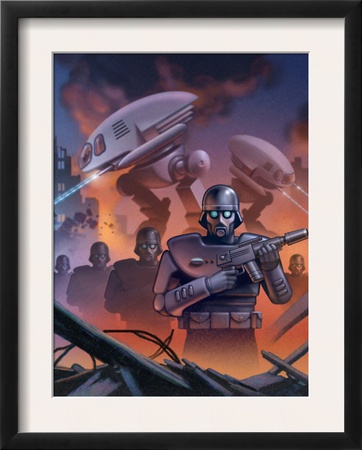
In this artwork, it depicts what looks to be society in ruins and chaos as robotic, emotionless soldiers, accompanied by war robots, lay fire and waste to the city. There’s smoke coming out from the fires, and there is debris or remains from the buildings that were destroyed in front of the soldiers’ march.
This sort of future is frightening; it suggests that a war on a grander scale could happen in the distant future and would lead the world down to ruins under the hands of a tyrannical country or world power. Or maybe, it would be a robot war; all of the soldiers and weapons used here in this picture are all mechanical. Maybe robots have developed a sense of being and realized that they were being oppressed and decided to wipe out humanity? Either way, the picture shown is ominous; it essentially depicts the end of humanity aside from maybe a couple of survivors that survived the wrath of the world power who created these machines.
The artist’s message through this artwork is probably to alert us the dangers of technology. The society of today has a general positive connotation when thinking about technology. Technology eases daily life, can help save lives, and can even provide numerous forms of entertainment in the form of movies, video games, and television. At the same time, if used in the wrong hands, technology can be also be used to create bombs, guns, or in general, just weapons of mass destruction designed for the use of war. The artist’s artwork makes us realize that; the dark and bleak colors used strengthen the overall ominous atmosphere that the artwork presents, and the presence of fire and weaponry signifies the dangers and risk associated with technology. Essentially, the core message of the artwork is that technology can be used for destructive purposes, and is not limited only to helping out society. The artwork provokes the idea from the viewers that we should be aware of both the positive and negative implications of technology; what it appears to be does not necessarily mean it’s going to be used in that way.
The promotion of technology nowadays is done through bright colors, reinforcing the positive aspects of using technology. In contrast the artist here used dark colors, reinforcing the negative aspects of technology. One wouldn’t expect the product being advertised to be “evil” if the advertisement had bright colors and an atmosphere like that as well. This is a manipulation to get us to buy the product; we associate bright colors with the idea that it can’t hurt us. However, brightness also “blinds” people from the truth, where as darkness makes people face the truth. The artist here isn’t hiding the fact that future technology could be used for war; he’s bluntly stating it through the bleak situation the artwork presents.
The House of the Scorpion - Clone "Racism"
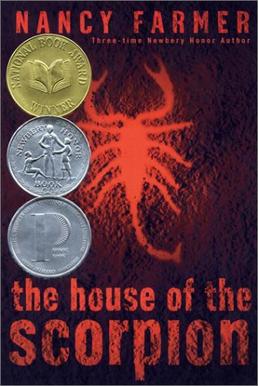
The House of the Scorpions revolves around the main character, Matt Alacran, as he develops and matures as a person from childhood, to a teenager, and finally, to an adult. But unlike other people, Matt is a clone who was only taken care of simply because the ruler of Opium, a fictional country between Mexico and the United States, would be subjected to health problems and would need the clone’s organs transplanted onto him to survive. Once Matt is found out to be a clone, the people around him treat him as if he was a monster and avoided him if it was unnecessary. Matt also goes through a state of denial and tries to convince himself that he is more than a clone.
Clones or replicas definitely present a moral issue if we were to somehow develop the means to do so in the future. Identity thefts, “racism” against clones, and potential killings of the original are all factors that could occur if clones were to happen in the future. Though it can see a medical purpose in terms of having the same blood types and organs as their originals, the “racism” against clones, and even against their originals would be a predominant effect if clones were to be developed for human beings. I would personally not support the idea of clones in the future; it’s okay for a movie or novel plot, but apply it to real life, and we may have an issue or issues that may not go away for centuries. It would be similar to the black struggle that we had about a century ago; even today, there is still some lingering stereotypes and racism present. The Ku Klux Klan still survives even to this day, proof that issues like racism are hard to kill and completely eliminate once introduced.
Nancy Farmer, through this novel, wanted to show how vulnerable people are when it comes to actually developing elements that people would normally see on sci-fi films. Exemplified by the people in the novel who just view Matt as a monster, most people in today’s society cannot deal with the supernatural or weird elements. Fancy technology makes them go “Wow!”, but in comparison, clones, ghosts, or really anything disconfigured in terms of biology freaks people out. After reading the work, Farmer is trying to get us to be more accepting of all the ideas, opinions, and even people out there in the world. Just because someone is different or doesn’t conform to today’s society doesn’t mean that he or she is evil and deserves to be shunned. The novel seems to imply that today’s society still has not grown accustomed to the brand new ideas lurking around there; tradition is still highly valued and anything different gets tossed in the trash. All of this is seen through the perspective of the main character of the novel; Farmer develops an emotional bond between her readers and the main character by being along with him through the entirety of his life. That way, her readers can understand and sympathize with him, which then leads to acknowledging one of the messages in the book.
Ar Tonelico - Cosmosphere Technology
In this scene from Ar Tonelico Qoga: Knell of Ar Ciel, Teppo, a “plug-in” for the Cosmosphere, analyzes and scans the soulspace, or the mind, of one of the main characters here, Finnel. After finishing the scan, Teppo reports back with the list of problems and suggested solutions for the main character, Aoto, to take.
The whole situation resembles that of handling a computer. Teppo represents something along the lines of maybe an anti-virus scanner, Finnel represents the computer itself, and Aoto represents the user. The only major difference is that the “computer” is an organic living being modeled after humans, has emotions, and is able to personally react and respond to situations. The Cosmosphere, or the soulspace, is the term the game uses to label Finnel’s mind, or going back to the computer analogy, the Cosmosphere would represent the hidden and protected files that normally, users shouldn’t touch if they want their computer to continue functioning. The Cosmosphere acts as a way for divers, or the users, to go inside the minds of their “computers” and help fix their emotional problems so that they can perform better. In a way, this also applies to the computer analogy as well; someone well-versed in modifying computer data can help boost performance speed and other functions of the computer.
If we had the ability to “dive” into the minds of people, it would be a cooler way of developing romantic relationships. Instead of say, going onto a date to the movies or eating out, one could dive into the mind of the other person and understand each other and resolve each other’s personal problems. At the same time… there would probably be a lot of relationship problems, and I would predict the marriage rate to plummet. I think a lot of people wouldn’t be able to handle the personal problems of their potential spouse, and they would just end up breaking down and breaking up with the person if they find a personal flaw while in their minds. As they go deeper into their minds, they would find a large number of serious problems that they would have to deal with, and if they can’t deal with it, then the relationship gets broken. There may be a personal issue if we allowed anyone to go inside each other’s mind, but if we modeled it after the Cosmosphere concept in this game, the person being dived into gets to reject anyone who they don’t want messing around in their minds. If the couple does survive being able to handle each other’s problems, then I think that would qualify as “true love.”
With the Cosmosphere concept in mind, I think the writers for this game probably wanted for the audience to think about the relationships that they have. Are people really friends with each other if they run away from each other’s problems and don’t help each other in some way with the problems? Are people really in love if they don’t care about each other’s problems? One of the messages, I think, is that to develop a genuine and strong bond, one needs to also genuinely care about other people’s problems, and help them out, whether it’s physically, or emotionally, like an encouragement. The way the game presents this message is actually through repetition. The player gets to explore other Cosmospheres other than Finnel’s, and resolve their personal issues and problems.
The possible future we could develop from this game obviously shows that in the present day, technology will continue to evolve as time passes on. But it also presents an idea of shallowness in today’s society that we see. Sometimes, we see people marry for money, or marry for beauty. Even in movies like Twilight, the love is irrational and not really for the right reasons. Real love is much more than that; it’s about confronting each other’s problems and supporting each other through thick and thin. On a lighter note... we are victims of cute and fluffy objects, e.g. Teppo.
Sunday, October 23, 2011
Feed - Technological Advancements
“...[I]t's not so much about the educational stuff but more regarding the fact that everything that goes on, goes on on the feed. All of the feedcasts and the instant news, that's on there, so there's all the entertainment I was missing without a feed, like the girls were all missing their favorite feedcast, this show called Oh? Wow! Thing! which has all these kids like us who do stuff but get all pouty, which is what the girls go crazy for, the poutiness.”
Feed by M.T. Anderson is about a dystopian society where everybody is connected mentally through something called a “feed.” It is essentially television and a computer in one’s mind, allowing infomercials, shows, news, and so on to be mentally displayed in one’s mind, as well as having “telepathy”, in the form of instant messaging between other “feeds”. However, this also means that corporate businesses who have this power can also manipulate people into thinking anything the businesses want them to think, which is in a sense, sort of a mind control device. “Feeds” are always on, unless hackers are involved or the feed somehow gets damaged.
I personally would not want to have a “feed” installed into my mind, even though I’m a huge fan of technology and its overall convenience. The part about being potentially brainwashed by the corporations does not really bother me too much as compared to the fact that it’s usually almost always on. That means that I would listen to something or somebody talk in my mind all day; I think that eventually, I would probably go crazy after listening to so much petty and useless information, not to mention that sleeping would be hard to do as well.
Anderson probably came up with the idea of “feeds” because of the overabundance of technology in the present day, or rather, even back in 2002, which was when this novel was published and released. He probably wanted to bring up the potential dangers of technology and if it is too considered too powerful in the hands of the capable who know how to use technology to their advantage. In Feed, the corporations can not only essentially brainwash people, but they can even interfere and wipe out undesired memories. Eventually, some day, we, as society, can probably replicate that, though it would be a forbidden taboo to do so, there are always some people out there who seek power and want to use it to further their own causes. One of the ways that Anderson uses to bring up the point that technology can be used for negative, manipulative purposes would actually be the way he describes the “feed” in the initial parts of the novel. It seems almost too good to be true with no negative drawbacks; it gives off entertainment, instant news, and even instant messaging. If we were to progress in the future and not think about the negative consequences, then perhaps we could be lulled into a false sense that everything is perfectly fine, when there are other malevolent forces at hand. Overall, Feed explores the impact of technology and its tremendous growth, and creates the thought of being careful with developing technology that is harmful, and not the type of technology designed to help people or assist in daily routines.
Feed depicts a world where corporate society rules over everything, including the government. This can be traced back to our own present, where the idea that money is power can hold true as well. The U.S. is in a debt of trillions of dollars, and even Apple has more spending money than the U.S. government alone. We are starting to lean on the path where corporate businesses actually have the potential to accomplish more things than the actual government because they have more money. In a sense, Anderson is advising us to make sure that there is a balance of power; the corporate businesses shouldn’t grow too powerful and usurp the government because of technological growth and money.
Subscribe to:
Posts (Atom)